Posted: September 18th, 2025
The Ultimate Guide to APA, MLA, and Chicago Referencing for U.S. Students-2025How to Reference in APA, MLA, and Chicago Styles:
Introduction
Writing academic papers in U.S. colleges requires more than just strong arguments and credible research—it also demands proper referencing. Professors emphasize citation styles because accurate referencing not only gives credit to original authors but also prevents plagiarism and strengthens your credibility as a student. Without clear citations, even well-researched work can lose its academic value. That’s why mastering citation rules is essential for success in American universities.
In the United States, three major citation styles dominate academic writing: APA (American Psychological Association, 7th edition), MLA (Modern Language Association, 9th edition), and the Chicago Manual of Style (17th edition). Each style has unique formatting guidelines for in-text citations, bibliographies, and reference lists. APA is widely used in social sciences, MLA in humanities and literature, while Chicago offers both author-date and notes-bibliography systems, making it popular in history and certain interdisciplinary fields.
This ultimate guide for 2025 breaks down the essentials of each system, provides practical examples, and equips you with the tools to apply the right style in your academic papers. By understanding APA, MLA, and Chicago referencing, you will not only impress your professors but also demonstrate academic honesty, critical thinking, and research discipline.
American Psychological Association (APA) style
The American Psychological Association (APA) style, now in its 7th edition, is one of the most commonly used citation systems in U.S. universities. It is especially popular in disciplines such as psychology, education, nursing, and the social sciences. APA is designed to prioritize clarity, consistency, and ease of reading, which makes it a favorite for research-based fields. Unlike some other citation styles, APA relies on the author-date system for in-text citations.
This means that every time a source is mentioned in the body of a paper, the author’s last name and the year of publication must appear in parentheses. For example, when paraphrasing, a proper citation would look like (Smith, 2020). When directly quoting, the page number must also be included, such as (Smith, 2020, p. 45).
Another key feature of APA is the reference list, which appears at the end of a paper and provides full bibliographic details for every source cited. Entries are arranged alphabetically by the author’s last name and formatted with a hanging indent. For instance, a book citation would appear as: Smith, J. A. (2020). Psychology in modern education. New York, NY: Academic Press. Journal articles follow a slightly different format that includes the Digital Object Identifier (DOI) when available: Brown, P., & Green, T. (2021). The impact of study habits on college success. Journal of Educational Research, 45(3), 210–225. https://doi.org/10.1234/jer.2021.567. Online sources, such as websites, are cited using the author or organization name, year, title, and direct URL: American Psychological Association. (2023). APA citation guide. https://apastyle.apa.org.
Overall, APA style offers a structured, professional way to acknowledge sources, reduce plagiarism, and improve the readability of academic writing. Mastering this system ensures that students in U.S. colleges meet the high standards of academic integrity expected in research and coursework.
Modern Language Association (MLA) style
The Modern Language Association (MLA) style, now in its 9th edition, is one of the most widely used citation systems in U.S. colleges and universities, especially within the humanities and liberal arts. Students studying literature, philosophy, history, and the arts often use MLA because it emphasizes clarity and precision when documenting sources. Unlike other styles that rely on author-date systems, MLA uses the author-page system for in-text citations.
This means that when you paraphrase information, you include only the author’s last name and the page number, such as (Smith 45). When directly quoting a source, the same rule applies. For example, you might write: “Studying regularly improves performance” (Smith 45). This method allows readers to quickly locate the original source in your Works Cited page without overloading the text with unnecessary details.
The MLA bibliography, called Works Cited, comes at the end of your paper and lists all the sources you referenced. Entries are arranged alphabetically by the author’s last name and follow a simple, consistent format. A standard book entry, for instance, would look like this: Smith, John. Psychology in Modern Education. Academic Press, 2020. For journal articles, MLA requires the author’s name, article title in quotation marks, journal title in italics, volume and issue number, publication year, and page range. An example would be: Brown, Peter, and Thomas Green. “The Impact of Study Habits on College Success.” Journal of Educational Research, vol. 45, no. 3, 2021, pp. 210–225.
MLA also provides a clear framework for citing digital sources such as websites. A typical entry includes the author or organization, the title of the page in quotation marks, the name of the website in italics, the publication date, and the URL. For example: American Psychological Association. “APA Citation Guide.” APA Style, 2023, https://apastyle.apa.org. By following MLA guidelines consistently, students can demonstrate strong academic integrity while making their papers more professional and credible.
Chicago Manual of Style
Meanwhile, the Chicago Manual of Style, now in its 17th edition, is widely used in history, business, fine arts, and publishing. Chicago is unique because it offers two systems: the Notes and Bibliography system and the Author-Date system. The Notes and Bibliography system is common in history and the humanities, where footnotes or endnotes are preferred. For example, you might insert a footnote like this: John Smith, Psychology in Modern Education (New York: Academic Press, 2020), 45. The bibliography entry for the same source would be: Smith, John. Psychology in Modern Education. New York: Academic Press, 2020. The Author-Date system, however, resembles APA. An in-text citation appears as (Smith 2020, 45), and the reference list would include: Smith, John. 2020. Psychology in Modern Education. New York: Academic Press.
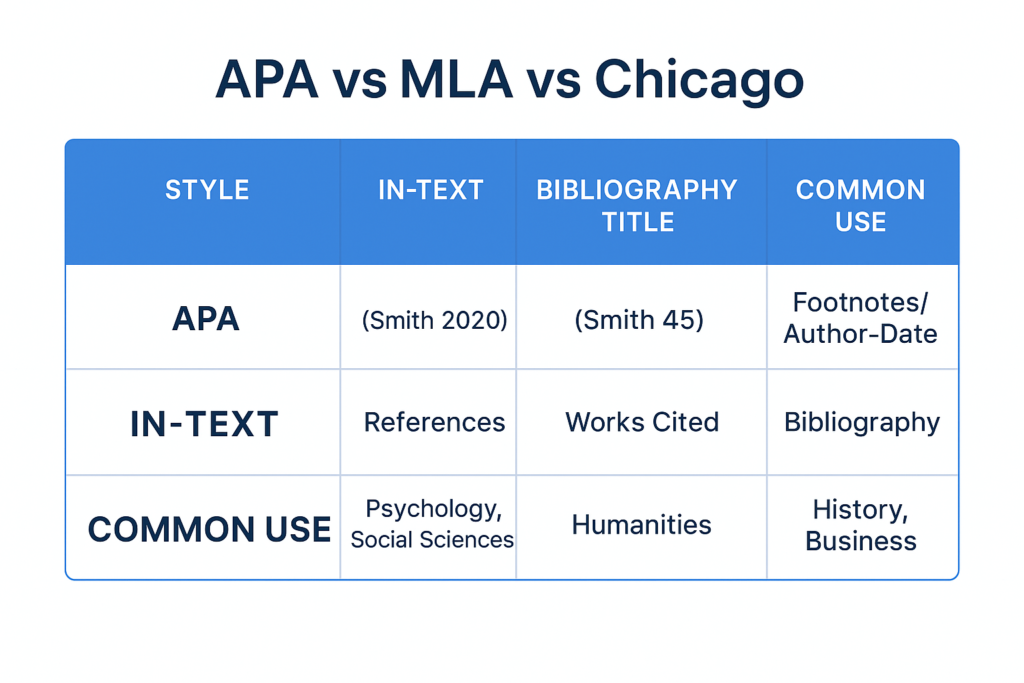
To make it easier for students, it helps to compare the three styles side by side. APA is the preferred style in psychology and social sciences, using an author-date system and a References page. MLA dominates the humanities, requiring author-page citations and a Works Cited list. Chicago is flexible, allowing either footnotes with a bibliography or an author-date system with a reference list. For instance, an APA book reference looks like Smith, J. (2020). Psychology in modern education., while MLA would cite it as Smith, John. Psychology in Modern Education. 2020., and Chicago would list it as Smith, John. Psychology in Modern Education. City: Publisher, 2020.
U.S. students often make common mistakes when citing sources. Mixing citation styles within a single paper is a frequent error, as is forgetting to include page numbers in direct quotes. Others struggle with capitalization rules for titles, missing DOIs or URLs for online sources, or inconsistent formatting with italics, commas, and periods. Avoiding these mistakes requires attention to detail and consistency throughout your work.
Thankfully, there are many tools available to make referencing easier. Websites like Citation Machine (citationmachine.net) offer free citation generators, while reference management software like Zotero and EndNote are excellent for organizing research projects. Grammarly can help with plagiarism checks and formatting, and the Purdue Online Writing Lab (OWL) remains one of the most reliable guides for citation help.
Best practices for referencing in U.S. colleges include always checking your professor’s assignment guidelines, since some universities adapt citation styles slightly. You should also be consistent with formatting, double-check any automated citations for accuracy, and maintain a running list of sources as you conduct research. This approach saves time and ensures nothing is missed in your final bibliography.
In conclusion, mastering APA, MLA, and Chicago referencing styles is an essential step for U.S. students who want to succeed in academic writing. These citation systems may differ in their rules, but they all share the same core purpose: giving proper credit to authors, strengthening your credibility, and safeguarding your work against plagiarism. For instance, APA emphasizes the author-date format widely used in the social sciences, MLA focuses on the author-page style common in the humanities, and Chicago offers both notes and bibliography or author-date systems, making it versatile for disciplines like history and business.
Although learning the details of each style can feel intimidating at first, the process becomes easier with practice. By carefully applying the rules, paying attention to formatting, and using citation tools or reference managers, you can gradually make referencing a natural part of your writing routine. Consistency and accuracy are key—qualities that professors and academic institutions expect from students.
Ultimately, becoming confident in these citation methods is not just about following rules; it reflects your commitment to academic integrity. When you cite properly, you show respect for other scholars’ contributions and demonstrate that your own work is grounded in credible, well-documented research.
If you still find referencing challenging, you’re not alone. Many U.S. students struggle with the complexity of citation rules, especially when juggling multiple assignments and deadlines. That’s why WriteMastersPro.com offers professional support with essays, research papers, and proper referencing in all major styles. With expert guidance, you can focus on your learning while we ensure your academic writing meets the highest standards.

Expert paper writers are just a few clicks away
Place an order in 3 easy steps. Takes less than 5 mins.