Posted: May 16th, 2025
Research Topic Selection Made Easy: Step-by-Step Guide for Students (2025)

Introduction
Choosing a research topic is often one of the most intimidating challenges students face in academic life. Whether you are preparing a term paper, a thesis, or a dissertation, the success of your project begins with one crucial decision: the research topic. A well-chosen topic can fuel your curiosity, sustain your motivation, and ultimately earn you higher grades. On the other hand, the wrong topic can lead to frustration, wasted hours, and a rushed final submission that falls short of expectations.
For many students, the hardest part isn’t writing the paper itself—it’s figuring out what to write about. With endless possibilities, narrowing down a topic that is interesting, researchable, and aligned with academic requirements can feel overwhelming. That’s why this guide is here: to simplify the process and give you the tools you need to make a confident choice.
In this complete student’s guide, we’ll explore why choosing the right research topic matters, break down a step-by-step process for selecting one, highlight common mistakes to avoid, and provide brainstorming strategies along with sample ideas. By the end, you’ll have the clarity to choose a topic that is specific, academically relevant, and personally engaging. Let’s dive in and unlock the power of a well-chosen research topic.
Why Choosing the Right Research Topic Matters
Here are four key reasons why selecting the right research topic matters so much:
- Engagement and Motivation – When you are genuinely interested in your topic, the process of researching and writing becomes more enjoyable. Instead of seeing the assignment as a chore, you’ll feel inspired to dig deeper, analyze critically, and present your ideas persuasively. A boring topic, on the other hand, can drain your energy and lead to procrastination.
- Depth of Analysis – A focused research topic allows for detailed exploration. Broad or vague topics often result in surface-level writing because there is too much ground to cover. A narrow, well-defined topic gives you the chance to dive deeper and present thoughtful, original insights.
- Relevance to the Field – Professors and academic institutions value topics that contribute to ongoing conversations within a discipline. A carefully chosen research topic engages with current debates, challenges existing perspectives, or fills a gap in the literature.
- Accessibility of Resources – Choosing a topic that is either too obscure or too broad can make it difficult to find appropriate sources. A well-chosen topic strikes a balance between originality and feasibility, ensuring you have enough credible materials to support your arguments.
Ultimately, a strong research topic demonstrates critical thinking, academic maturity, and initiative. Professors can tell when a student has taken the time to make a thoughtful choice, and this often translates into higher grades.
Step-by-Step Guide to Choosing a Research Topic
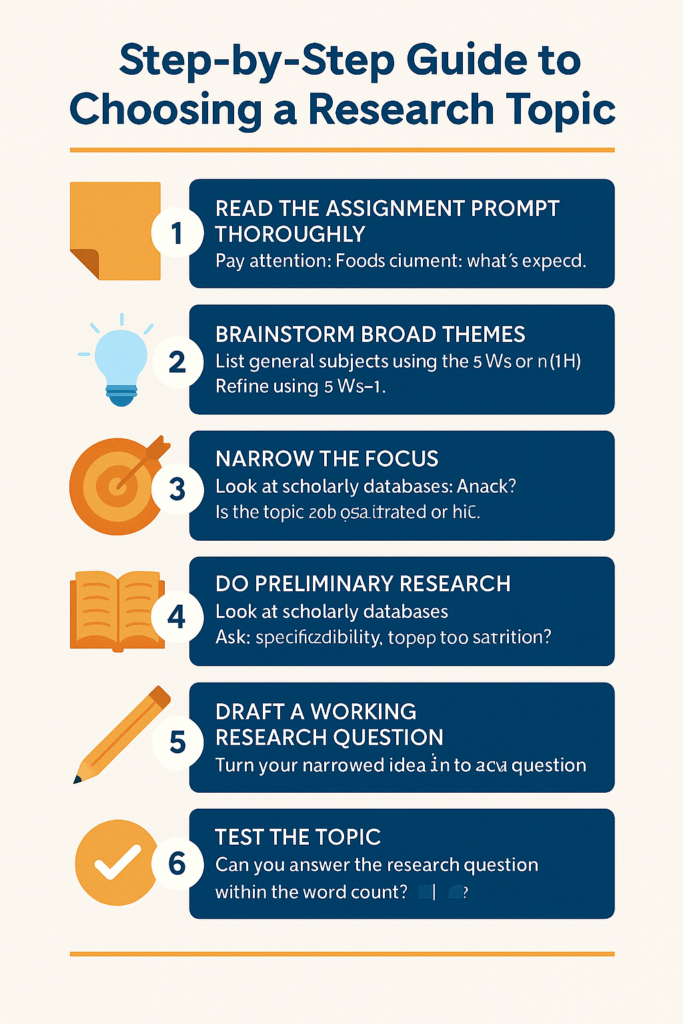
Step 1: Read the Assignment Prompt Carefully
The first step is often the most overlooked—understanding your professor’s expectations. Before you start brainstorming, carefully review the assignment guidelines. Look for details such as:
- Word count or page limit – This helps you decide how broad or narrow your topic should be.
- Citation style (APA, MLA, or Chicago) – Some topics may align better with the type of sources commonly cited in your field.
- Thematic focus – Many courses have overarching themes (e.g., globalization in political science, sustainability in business, trauma in psychology). Staying aligned with course themes shows you understood the assignment.
- Source requirements – Some professors require scholarly, peer-reviewed articles, while others may allow a mix of academic and non-academic sources.
If anything in the instructions is unclear, don’t hesitate to ask your professor for clarification. Misinterpreting the assignment can derail your entire project.
Step 2: Brainstorm Broad Themes
Once you understand the requirements, begin generating ideas. Think about broad subjects that interest you and that are relevant to the course. For instance:
- Psychology: memory, cognitive behavior, childhood development, trauma
- Business: entrepreneurship, corporate leadership, digital marketing, sustainability
- History: revolutions, colonial legacies, historical figures, resistance movements
- Literature: symbolism, postcolonial narratives, dystopian fiction, women writers
Choose themes that genuinely spark your interest. Writing a paper can take weeks or months, and motivation will be much easier to maintain if you are passionate about your subject.
Step 3: Narrow the Focus
A broad theme like “climate change” is too vast to cover in a single paper. To narrow it down, use the 5Ws and 1H method—Who, What, When, Where, Why, and How.
Instead of writing about climate change in general, ask:
- Who is affected? (e.g., rural farmers, coastal communities)
- What specific aspect are you exploring? (e.g., crop yields, migration, public health)
- Where is it happening? (e.g., Sub-Saharan Africa, Southeast Asia, U.S. cities)
- When? (e.g., last 20 years, post-industrial era, future projections)
- Why does it matter? (e.g., policy impact, economic stability, food security)
- How is it happening? (e.g., rising sea levels, unpredictable rainfall patterns)
Refining your topic makes it more manageable and increases the chances of producing a high-quality paper.
Step 4: Do Preliminary Research
Before finalizing your topic, spend some time exploring academic databases. Use platforms like:
- Google Scholar
- JSTOR
- PubMed (for health sciences)
- Your university library database
As you skim through abstracts, ask yourself:
- Are there enough scholarly sources available?
- Are the studies recent and relevant?
- Is the research question still debated, or is it settled?
Preliminary research helps you confirm that your topic is both feasible and worthwhile.
Step 5: Draft a Working Research Question
Once you’ve narrowed your focus, transform it into a clear research question. For example:
- Broad topic: Remote learning
- Focused topic: Remote learning and college students
- Research question: “What are the psychological effects of remote learning on first-year college students in the U.S.?”
Your research question should be specific, researchable, and open to critical analysis. A good question is neither too broad nor too restrictive.
Step 6: Test the Topic
Finally, test the practicality of your topic by asking:
- Can I fully explore this within the word limit?
- Does it meet the assignment criteria?
- Am I personally interested in exploring it further?
If the answer to all three is yes, you’ve found a strong research topic.
Common Mistakes Students Make When Choosing a Research Topic
Even with good intentions, students often fall into traps when selecting a topic. Here are the most common mistakes—and how to avoid them:
- Choosing a Topic That’s Too Broad
Example: “The History of Technology.” This could easily fill entire volumes. Instead, focus on a narrower angle, such as “The Role of Smartphones in Teen Communication Over the Last Decade.” - Picking a Vague or Unclear Topic
A vague topic confuses both writer and reader. Always define your focus clearly and specifically. - Selecting a Topic with Limited Research
Some unique topics may sound exciting but lack sufficient academic sources. Avoid subjects that are too obscure unless you are confident you can support your arguments. - Ignoring the Assignment Prompt
Even an excellent paper will receive a poor grade if it doesn’t meet your professor’s criteria. Always double-check that your topic aligns with the assignment. - Being Overly Ambitious
Choosing a topic that requires extensive knowledge, data collection, or expertise may overwhelm you. Keep your scope realistic based on the time and resources you have.
Tips for Narrowing Down Broad Ideas
It’s common for students to start with a large, overwhelming concept like “Artificial Intelligence” or “Globalization.” Here’s how to narrow it effectively:
- Pick a Specific Domain – For AI, decide whether you want to focus on healthcare, education, law enforcement, or marketing.
- Define the Impact – Are you interested in job loss, ethical implications, accuracy, or human-AI interaction?
- Identify the Population – Who is affected? For example, students, doctors, employees, or consumers.
Example of a well-narrowed topic: “How is artificial intelligence improving early diagnosis in pediatric healthcare?”
This topic is targeted, researchable, and academically meaningful.
Tools and Resources for Brainstorming Research Topics
If you’re stuck, here are some excellent tools and resources to spark ideas:
- Google Scholar – Browse recent studies and see what’s trending in your field.
- JSTOR – Access peer-reviewed journals across disciplines.
- Quora and Reddit – See what real people are asking in your subject area.
- Topic Generators – Tools like HubSpot’s Blog Ideas Generator or ChatGPT can give you new angles.
- Citation Trails – Check the references in one useful article; they often lead to more great sources.
Final Checklist Before Committing to a Research Topic
Before you lock in your choice, ask yourself:
- Does it align with the assignment requirements?
- Is it specific and clearly defined?
- Can I find enough credible sources?
- Am I personally interested in exploring it?
- Can I realistically cover it within the required length?
Taking a few extra minutes to review this checklist can save you hours of frustration later.
Sample Research Topic Ideas for Inspiration
Sometimes all you need is an example to get your creativity flowing. Here are sample research topics across disciplines:
- Psychology: How does social media affect self-esteem in teenagers?
- Sociology: What are the effects of remote work on urban-to-rural migration?
- Education: Does gamification improve learning outcomes in elementary schools?
- History: What role did women play in resistance movements during World War II?
- Health Sciences: How effective are mindfulness practices in managing chronic pain?
- Literature: How does dystopian fiction reflect contemporary political anxieties?
These examples are narrow enough to be researchable yet broad enough to allow for meaningful exploration.
Conclusion: Your Research Topic Is Your Foundation
The best research papers come from students who are genuinely curious about their subject. That curiosity begins with selecting a topic that sparks interest, raises important questions, and connects to ongoing academic discussions. By carefully following a structured process—understanding the assignment, brainstorming ideas, narrowing your focus, conducting preliminary research, and drafting a research question—you can avoid common mistakes and create a strong foundation for success.
Remember: every great academic project begins with uncertainty, but it ends with clarity when you choose your topic wisely. And if you ever feel stuck, know that you don’t have to go through the process alone. At WriteMastersPro, we provide expert guidance to help students brainstorm, refine, and polish their research topics—so you can move forward with confidence and write papers that truly stand out.

Expert paper writers are just a few clicks away
Place an order in 3 easy steps. Takes less than 5 mins.